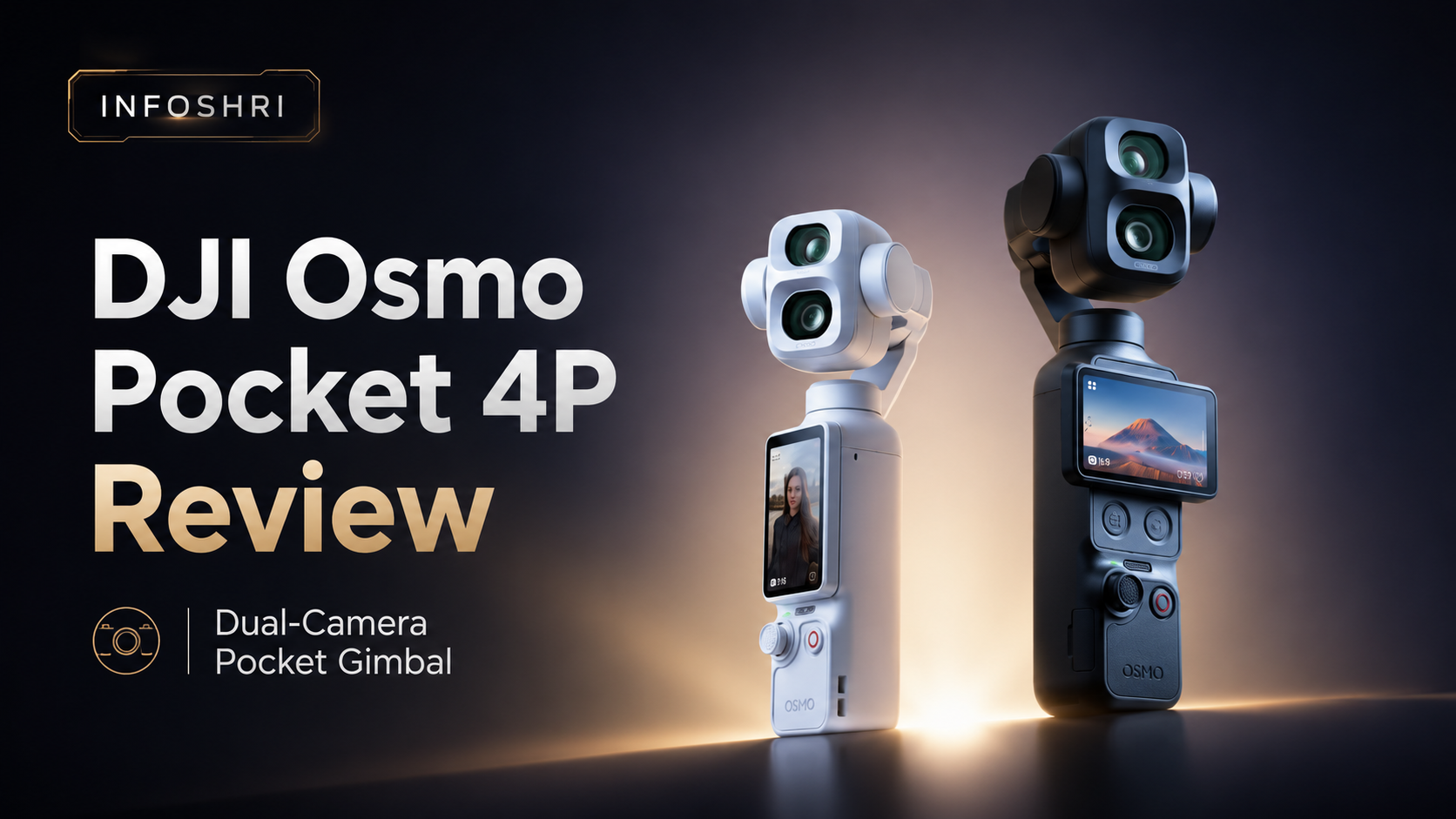
DJI has taken a much bigger step with the Osmo Pocket 4P than the name might suggest. This is not simply an Osmo Pocket 4 with a few extra software features. It adds a real second camera: a 60mm-equivalent telephoto lens alongside the familiar wide camera, while the main 1-inch sensor receives DJI’s new LOFIC imaging technology and D-Log 2 profile.
That combination gives the Pocket 4P something previous Pocket cameras could not offer: you can shoot a wide travel scene, turn toward a person, and capture a much more natural portrait or detail shot without physically walking closer or attaching another camera.
More importantly, independent laboratory testing shows that the new wide camera is not merely marketing. CineD measured exceptionally high dynamic range from it. But there is a catch: the 60mm camera is not equal to the 20mm camera in image quality or Log workflow, so thinking of the Pocket 4P as two identical professional cameras would be a mistake. (CineD lab test)
For buyers in India there is another issue to understand before paying: several Indian retailers are already selling the camera, but DJI’s current official online-store country selector does not provide an India storefront. Retailer pricing, warranty wording and even technical specifications vary significantly, so the seller you choose matters almost as much as the price. (DJI dealer guidance)
Research disclosure: This is an independent research-based editorial review, not a hands-on InfoShri test. The conclusions below are based on current DJI documentation, independent laboratory measurements, published hands-on reviews and current retailer research checked on September 4, 2026.
Quick verdict
The DJI Osmo Pocket 4P is currently one of the strongest compact gimbal cameras available for a creator who values image quality, stabilization, tracking and real optical framing flexibility in one small device.
Its biggest strength is actually not 4K/240fps, 12× zoom or even the second camera. It is the combination of a very capable 20mm 1-inch wide camera, three-axis mechanical stabilization, useful autofocus and tracking, fast workflow, and a genuine 60mm camera when you need tighter framing.
The wide camera is the star. CineD measured 16 stops at SNR=2 and 17.2 stops at SNR=1 in 4K D-Log 2, while its exposure-latitude testing produced a very strong 10 stops with some room toward 11. Those are unusually good results for such a small camera. (CineD)
The telephoto camera is useful rather than equally spectacular. CineD measured 11.6 stops at SNR=2 and about eight stops of exposure latitude from the 60mm camera. PetaPixel also found its highlight retention noticeably weaker and warned that switching between wide-camera D-Log 2 and tele-camera D-Log can produce visibly different footage. (CineD) (PetaPixel)
So the Pocket 4P earns a strong recommendation for travel filmmaking, solo content creation, documentary-style work, events, family videos, YouTube production and compact commercial work. If you mostly shoot ordinary wide-angle vlogs, however, the cheaper Osmo Pocket 4 is the more rational purchase. If budget is the priority, the heavily discounted Pocket 3 remains extremely relevant.
And if you are considering Insta360, the Luna Ultra has several clever advantages—8K, a detachable display and a common I-Log workflow across its cameras—but current independent lab results strongly favour the Pocket 4P for serious Log-image quality. (CineD Luna Ultra lab test)
What exactly is the DJI Osmo Pocket 4P?
DJI unveiled the Osmo Pocket 4P at Cannes in May 2026 as the premium member of its pocket-gimbal family. DJI’s current lineup places it above the single-camera Pocket 4 and Pocket 3. Official regional stores list all three models simultaneously, so the Pocket 4P is not a replacement for the Pocket 4; it is the more expensive dual-camera option. (DJI Pocket Series)
Physically, it remains a small vertically oriented camera attached to a three-axis motorized gimbal. The whole device weighs 230g and measures approximately 159.5 × 63.3 × 33.5mm. Its screen is a rotating 2-inch, 1000-nit touchscreen. (DJI specifications)
The important change sits above that screen.
There are now two separate imaging systems:
| Camera | Sensor | Equivalent focal length | Aperture | Minimum focus |
|---|---|---|---|---|
| Wide | 1-inch CMOS | 20mm | f/2.0 | 9cm |
| Med-tele | 1/1.28-inch CMOS | 60mm | f/1.8 | 20cm |
That 20mm-to-60mm difference is much more meaningful than the simple label “3× zoom” makes it sound.
A 20mm lens is wide. It is excellent when you are holding the camera at arm’s length, walking through a city, filming a room, shooting landscapes or trying to include yourself and the background.
A 60mm lens gives a much tighter perspective. It is more flattering for faces, better for food and product detail, useful for stages and events, and lets you isolate subjects without pushing a wide camera digitally into the scene.
One point needs clarification: although the Pocket 4P physically contains two cameras, both cameras do not record simultaneously. DJI says only one lens operates while shooting; the device switches to the appropriate physical camera depending on focal-length selection.
DJI Osmo Pocket 4P specifications that actually matter
| Specification | DJI Osmo Pocket 4P |
|---|---|
| Main sensor | 1-inch CMOS |
| Tele sensor | 1/1.28-inch CMOS |
| Main lens | 20mm equivalent, f/2.0 |
| Tele lens | 60mm equivalent, f/1.8 |
| Normal video | Up to 4K 60fps |
| Wide-camera slow motion | Up to 4K 240fps |
| Tele-camera slow motion | Up to 4K 200fps |
| Vertical video | Up to 3K 60fps in 9:16 |
| Photo resolution | Approx. 37MP |
| Maximum video bitrate | 180Mbps |
| Video codec | HEVC/H.265 |
| Internal storage | 103GB |
| microSD | Up to 1TB |
| Display | 2-inch, 1000 nits |
| Stabilization | Three-axis mechanical gimbal |
| Built-in microphones | 3 |
| Battery | 1545mAh / 11.95Wh |
| Claimed operating time | Up to 210 minutes under DJI’s test conditions |
| Charging | 80% in 18 min; 100% in 32 min |
| Weight | 230g |
| Wi-Fi | Wi-Fi 6-class 802.11ax support |
| Bluetooth | BLE 5.4 plus BR/EDR |
These figures come from DJI’s current official specifications. The battery figure deserves special caution: the quoted 210 minutes was measured at 1080p/24fps with Wi-Fi and the screen switched off at 25°C. It should not be interpreted as 210 minutes of 4K recording with tracking, the display and wireless audio active. (DJI specifications)
Ignore Indian listings that claim 6K video
This is an unusually important buyer warning.
At least some current Indian retailer listings advertise the Pocket 4P as a “6K” camera. That conflicts with DJI’s official specification sheet. DJI lists normal recording up to 4K/60fps, with high-frame-rate slow motion reaching 4K/240fps on the wide camera and 4K/200fps on the tele camera. (Design Info listing) (DJI specifications)
If you see “6K recording” on a seller page, do not use it as a reason to pay more. It appears to be erroneous retailer copy, not an official Pocket 4P capability.
The 20mm wide camera is the real technical breakthrough
The second lens gets most of the attention because it is easy to demonstrate. The technically more significant improvement is inside the wide camera.
DJI uses a new 1-inch sensor incorporating LOFIC, or lateral overflow integration capacitor technology. Without turning this into an electronics lesson, the practical goal is simple: preserve more information in very bright areas while retaining usable detail in darker areas of the same image.
Think about filming someone standing indoors beside a bright window. A weaker camera may force you to choose between a properly exposed face and a window that turns white. More dynamic range gives you more ability to hold both.
DJI markets the camera as offering up to 17 stops of dynamic range with its D-Log 2 workflow. Manufacturer dynamic-range claims should normally be treated cautiously, because different testing methods can produce very different numbers. In this case, however, independent testing found something unusually close to DJI’s headline. (DJI product page)
CineD measured the wide camera at:
| Independent CineD measurement | Result |
|---|---|
| Dynamic range, SNR=2 | 16 stops |
| Dynamic range, SNR=1 | 17.2 stops |
| Exposure latitude | Solid 10 stops, with some room toward 11 |
| Rolling shutter | 11ms |
(CineD)
Those numbers need interpretation.
The 17.2-stop result does not mean this tiny camera suddenly becomes an ARRI cinema camera. Signal-to-noise threshold, codec bit depth, processing, color, highlight behaviour and exposure latitude all matter. CineD itself found that once footage was pushed hard, the compressed 10-bit codec eventually showed posterization and noise.
Its roughly 10-stop practical exposure-latitude result is therefore more useful than simply repeating “17 stops.” Even so, it is an exceptional result for a camera weighing 230g. (CineD)
PetaPixel reached a more conservative conclusion in its real-world comparison against a Panasonic S1 II. Its reviewer did not observe what looked like a full 17-stop advantage, but still described the Pocket 4P’s wide-camera performance as extremely impressive and noted improved low-light performance over the Pocket 4. (PetaPixel)
These findings are not really contradictory. CineD performed instrumented measurements at specified noise thresholds, while PetaPixel compared usable real-world footage. Together they tell a more useful story: DJI’s number has technical support, but you should buy the camera for its genuinely strong files—not because “17” is magically better than every camera advertising 14 or 15 stops.
D-Log 2 is excellent, but the dual-camera Log workflow needs improvement
D-Log 2 is designed to retain the wide camera’s unusually large tonal range for later colour grading.
If terms such as Log and grading are unfamiliar, imagine a video that deliberately looks flat and low-contrast when recorded. That flat appearance stores more highlight and shadow information. You later restore contrast and colour during editing.
This matters to filmmakers. It matters much less if you simply want attractive clips directly from the camera.
The problem is that D-Log 2 belongs to the wide camera, not the whole dual-camera system.
PetaPixel found that when the main camera was set to D-Log 2, attempting to select the tele camera produced a message explaining that 10-bit D-Log 2 supports only 1× zoom. The reviewer then had to change to the older D-Log profile before using the 60mm camera. He also found that exposure behaviour differed enough between the two cameras to make a professional two-lens Log workflow more cumbersome than it should be. (PetaPixel)
This is probably the single most important limitation for an advanced buyer.
For someone shooting Standard colour, the second camera is straightforward and useful.
For someone carefully exposing D-Log 2 and planning a heavily graded short film, it is less seamless. You cannot assume that switching from 20mm to 60mm gives you the same image pipeline with a different focal length.
Future firmware could improve parts of the workflow, but buyers should judge the camera by what it does now rather than by a possible update.
The 60mm telephoto is valuable—but it is not a second 1-inch flagship camera
DJI pairs the tele lens with a smaller 1/1.28-inch sensor. Its f/1.8 aperture sounds faster than the wide camera’s f/2.0 lens, but sensor size and image processing matter as well.
CineD measured the tele camera at 11.6 stops of dynamic range at SNR=2 and 12.9 stops at SNR=1, with approximately eight stops of exposure latitude. Those are respectable results, but substantially behind the wide camera. (CineD)
PetaPixel similarly found the 60mm camera more vulnerable to blown highlights and observed less natural tonal transitions on faces in difficult contrast. (PetaPixel)
That does not make the lens bad.
It changes how you should think about it.
The tele camera is valuable because 60mm gives you photographs and video shots a 20mm camera cannot naturally reproduce. Portraits look different. Background compression changes. Product details become easier. You can shoot somebody across a room without putting a camera directly in front of their face.
For travel films, weddings, restaurants, documentary B-roll, events, fashion, interviews and cinematic inserts, this can be more useful than another increase in resolution.
But when lighting is extremely difficult and maximum grading flexibility matters, use the wide camera wherever possible.
Is 12× zoom really useful?
DJI advertises up to 12× zoom, but buyers should separate three different ideas: physical focal lengths, cropping and digital magnification.
The two true physical shooting positions are effectively the 20mm wide camera and 60mm tele camera. DJI describes the latter as 3× optical zoom relative to the wide view. Digital zoom then extends farther, with normal video supporting up to 12×. Slow-motion and timelapse restrict you to the 1× and 3× optical positions. (DJI specifications)
The practical hierarchy is simple.
The 1× wide camera should be your image-quality default. The 3× 60mm camera is the important second focal length. Higher zoom levels are framing tools, not replacements for a real longer telephoto lens.
A “12×” number on a tiny camera can sound as though you have a wildlife superzoom in your pocket. You do not.
DJI does, however, extend ActiveTrack across the focal range. Its support documentation states that tracking distance increases with zoom, with approximate supported ranges stretching from around 0.5–10m at 1–2× to around 3–50m at 6–12× under appropriate conditions. That makes telephoto tracking much more interesting for stages, sports practice and subjects you cannot physically approach.
4K/240fps sounds incredible—understand where you can use it
The Pocket 4P’s headline maximum is 4K/240fps, but that is a slow-motion mode on the wide camera.
Normal 16:9 4K recording tops out at 60fps. The wide camera supports 4K slow motion at 100, 120, 200 and 240fps, while the 60mm tele camera reaches 4K/200fps. (DJI specifications)
That is still impressive.
At 240fps, footage played on a 30fps timeline can be slowed dramatically while preserving fluid motion. It is excellent for splashing water, sports movement, cooking shots, hair movement, fabric, product shots and cinematic inserts.
But very high frame rates normally need considerably more light than 24 or 30fps footage, and they are not the mode you will use for an entire vlog.
For normal filmmaking, 4K/24, 25, 30 or 60fps will matter far more.
The camera also provides a dedicated low-light mode up to 4K/30fps. (DJI specifications)
One limitation for vertical creators: it is 3K, not native 4K vertical
Turning the 2-inch screen changes orientation, and DJI supports vertical recording directly.
The maximum official 9:16 normal-video setting is 1728 × 3072 at up to 60fps, which DJI calls 3K—not 2160 × 3840 4K vertical. (DJI specifications)
For Instagram Reels, YouTube Shorts and TikTok, 3K is already substantially above typical delivery resolution, so this is unlikely to hurt normal social use.
It matters more if your workflow specifically requires native 4K vertical masters.
Interestingly, the newly launched Insta360 Luna Pro supports 2160 × 3840 vertical video at up to 30fps according to Insta360’s current specification table, although the Luna Pro is currently a China-market product rather than a confirmed India buy-now alternative. (Insta360 Luna-series documentation)
Stabilization and tracking remain a major reason to buy a Pocket camera
Many modern phones shoot excellent video, so why buy another camera?
The gimbal is one of the answers.
The Pocket 4P uses mechanical three-axis stabilization. Instead of correcting movement mainly by electronically cropping and warping the image, motors physically move the camera assembly to keep it stable.
For walking shots, pans, reveals and follow shots, that changes the visual character of the footage.
DJI’s ActiveTrack system can recognize and follow people and other subjects. Its current support documentation also describes advanced subject tracking and registered-subject workflows.
Digital Camera World’s hands-on review found the second camera especially valuable for solo operation and praised the creative flexibility of the 60mm view. (Digital Camera World)
TechRadar, after using the camera for approximately a month, likewise praised its stabilization and tracking while noting that the larger dual-camera design reduces some of the effortless pocketability associated with earlier models. (TechRadar)
So yes, “Pocket” still describes the concept, but Pocket 4P buyers should expect a more substantial object than Pocket 3.
Autofocus is smarter, but it is not infallible
DJI provides autofocus and tracking behaviours intended for normal shooting, subject follow and creator workflows.
For YouTubers reviewing gadgets, beauty products, food or anything held close to the lens, reliable subject-selection behaviour can remove a surprisingly common frustration: the camera remaining focused on the presenter’s face when the product needs to become sharp.
Independent owner feedback is still relatively young because the 4P is a new camera. Some early reports praise the image quality but mention occasional focus hunting or distraction by foreground objects. That should currently be treated as an owner-experience signal, not evidence that every unit has an autofocus problem.
The more important point is that a sophisticated tracking system still cannot replace sensible shooting technique. For a critical interview or product shot, verify focus instead of assuming the AI has made the right decision.
Audio is unusually creator-friendly
There are three built-in microphones, but DJI’s wireless-microphone integration is more important for serious content.
DJI’s current ecosystem allows direct wireless-microphone integration with compatible DJI transmitters, reducing the need for a separate receiver in common creator setups.
That is a meaningful advantage for a small rig.
A solo presenter can wear one transmitter. A two-person setup can use a compatible two-mic workflow. You avoid unnecessary hardware hanging from the side of the camera and preserve the compact nature of the system.
If you already own compatible DJI audio equipment, this ecosystem integration adds real value to the Pocket 4P relative to comparing bodies only by sensor size.
Osmo FrameTap makes solo shooting more practical
DJI also supports the Osmo FrameTap, a compact external preview and control device in the Pocket 4P ecosystem.
This matters when the Pocket 4P is on a tripod across the room and the creator needs remote framing or control.
Insta360’s Luna series approaches this problem differently with a detachable touchscreen that itself becomes the remote display. That is arguably the more elegant hardware design. DJI’s approach instead benefits from a mature Pocket ecosystem and optional accessories.
Storage is one of the Pocket 4P’s underrated advantages
The camera includes 103GB of usable internal storage before you insert a card. It also accepts microSD cards up to 1TB. (DJI specifications)
Internal storage is useful for a simple reason: forgetting your memory card no longer automatically ruins the shoot.
DJI specifies a maximum video bitrate of 180Mbps, so demanding modes can consume storage quickly. A serious user should still buy a good V30 microSD card, particularly for travel or long shooting days.
The workflow is fast as well. DJI’s current Pocket-series support documentation confirms wired, wireless and computer-based export methods for the Pocket 4P. (DJI export guide)
Battery life: 210 minutes needs context
DJI quotes 210 minutes of operating time.
That sounds like three and a half hours, but the laboratory conditions matter: 1080p/24fps, 25°C, screen off and Wi-Fi off. (DJI specifications)
A creator recording high-bitrate 4K, using the touchscreen, tracking a subject and connecting a wireless microphone should expect less.
What is more impressive for daily use is the charging speed. DJI specifies approximately 18 minutes to reach 80% and 32 minutes for a full charge under its stated test conditions.
For all-day event coverage, a compatible battery-handle or external charging strategy can be more useful than obsessing over the headline runtime figure.
Is the Pocket 4P waterproof?
DJI’s current Pocket 4P specification sheet does not list an IP waterproof or dust-resistance rating. (DJI specifications)
That is enough reason not to treat this as an action camera.
The mechanically exposed gimbal, rotating display and optical assembly serve a very different purpose from an Osmo Action camera. If you need to film in heavy rain, underwater, on a surfboard, through mud or in similarly hostile conditions, an action camera is the more appropriate tool unless DJI provides an approved protective solution for your intended use.
For travel creators, the practical rule is simple: carry protection for rain and dust.
Timecode makes it more useful in professional multi-camera work
A feature that casual users may never notice could matter enormously to production teams: Pocket 4P supports professional synchronization workflows including timecode-related use cases documented by DJI.
Timecode gives individual video frames synchronized timing information. If you record an interview using multiple cameras and external audio, that can make post-production synchronization far easier.
It does not turn the Pocket 4P into a cinema camera, but it reinforces that DJI expects it to be used for more than casual holiday clips.
DJI Osmo Pocket 4P price in India: do not shop by price alone
India is where the buying decision becomes complicated.
As rechecked on September 4, 2026, current specialist-retailer listings included approximately:
| Seller listing | Version | Observed price |
|---|---|---|
| Jetayu Gadgets | Standard Combo | ₹71,999 |
| Design Info | Standard Combo | ₹74,999 |
| djistore.in | Standard Combo | ₹76,999 |
| djistore.in | Vlog Combo | ₹85,899 |
| Jetayu Gadgets | Vlog Combo | ₹91,999 |
| RetinaPix | Vlog Combo | ₹99,990 |
Prices are snapshots, not official permanent MSRPs, and may change quickly. (Jetayu) (Design Info) (djistore.in) (RetinaPix)
The lowest number should not automatically win.
DJI’s own dealer guidance says buyers should use its dealer-verification resources rather than relying only on claims made by a retailer. (DJI dealer guidance)
That means an Indian buyer should verify four things before paying: the exact seller’s DJI authorization status, the region of the supplied unit, the written warranty that applies to that serial number, and whether a proper GST invoice is included.
A retailer calling itself “DJI Store India” or “authorized” on its own website is not, by itself, independent proof of DJI authorization.
What about DJI Care Refresh?
The Pocket 4P is part of DJI’s current product ecosystem, but plan availability and cross-region coverage should be verified for the exact serial number and purchase channel.
Before buying an expensive imported or cross-region unit, verify eligibility using the actual serial number and purchase channel instead of assuming that global product support equals India-specific entitlement.
Pocket 4P vs Pocket 4 vs Pocket 3
This may be the most important comparison because many people do not actually need the 4P.
| Feature | Pocket 4P | Pocket 4 | Pocket 3 |
|---|---|---|---|
| Wide sensor | New 1-inch | New 1-inch | 1-inch |
| Dedicated tele camera | Yes, 60mm | No | No |
| Maximum advertised DR | Up to 17 stops | Up to 14 stops | 12.5 stops |
| Main max slow motion | 4K/240 | 4K/240 | 4K/120 |
| Tracking reach | Up to 12× zoom | Up to 4× zoom | ActiveTrack |
| Internal storage | 103GB | 107GB | No comparable large internal store |
| Claimed runtime | 210 min | 240 min | 166 min |
| Positioning | Dual-camera flagship | Single-camera premium/value | Lower-cost classic option |
DJI’s current family pages list all three products together, which makes their intended roles unusually clear. (DJI Pocket Series)
Buy the Pocket 4P over Pocket 4 when the 60mm lens genuinely matters
If you shoot people, weddings, events, travel details, products, food, cinematic B-roll or documentary footage, the 60mm lens can change your finished video.
If 90% of your footage is arm’s-length vlogging, landscapes and walk-and-talk shooting at 1×, paying the premium largely to acquire a second lens you rarely select makes little sense.
The Pocket 4 also has a longer 240-minute headline battery figure and is significantly cheaper in current international pricing. DJI’s Singapore store currently lists the 4P Standard Combo at USD $609 and Pocket 4 at USD $473. (DJI Pocket Series)
Pocket 3 remains the money-saving choice
Pocket 3 is older and technically behind both Pocket 4 models, but its 1-inch sensor, mechanical gimbal, rotatable screen and 4K/120fps capability are still enough for a huge number of YouTube and travel creators.
India makes this comparison especially interesting. Current price tracking showed the standard Pocket 3 around ₹35,990 in early September 2026. (Smartprix)
At roughly half the observed cost of a Pocket 4P Standard Combo, the Pocket 3 can be the smarter first creator camera even though the 4P is clearly the more capable machine.
Pocket 4P vs Insta360 Luna Ultra
This is the real flagship fight.
Both cameras use a 20mm-equivalent 1-inch main camera plus a physical 60mm secondary camera. Both have mechanical gimbals. Both target serious creators.
But their philosophies differ substantially.
| Feature | DJI Osmo Pocket 4P | Insta360 Luna Ultra |
|---|---|---|
| Main sensor | 1-inch | 1-inch |
| Tele sensor | 1/1.28-inch | 1/1.3-inch |
| Main lens | 20mm f/2.0 | 20mm f/1.8 |
| Tele lens | 60mm f/1.8 | 60mm f/2.0 |
| Maximum resolution | 4K normal video | 8K/30 |
| High-speed video | Up to 4K/240 wide | Up to 4K/120 |
| Professional Log | D-Log 2 wide; D-Log tele | 10-bit I-Log |
| Screen | Fixed/rotating camera display | Detachable wireless OLED |
| Internal storage | 103GB | 47GB |
| Max card | 1TB | Up to 2TB |
| Manufacturer battery figure | 210 min | 240 min under screen/Wi-Fi-off test |
| Weight | 230g | 233–235g |
(DJI specifications) (Insta360 Luna-series documentation)
On specifications alone, Luna Ultra can look stronger. 8K, a detachable screen, 2TB card support and a consistent I-Log concept are attractive.
Independent laboratory testing changes the picture dramatically.
CineD had serious problems with Luna Ultra’s I-Log image pipeline. Its test found aggressive internal noise reduction in most tested modes, invalidating several normal dynamic-range measurements. It measured only 4–5 stops of exposure latitude on the wide camera and about five on the tele camera in the tested 8K I-Log workflow. The tele camera’s one cleanly measurable 8K mode produced 9.7 stops at SNR=2. (CineD Luna Ultra lab test)
The same lab measured the Pocket 4P at roughly ten stops of wide-camera exposure latitude and eight on the tele camera. (CineD Pocket 4P lab test)
That makes the current recommendation fairly clear for a creator who cares about aggressive grading: Pocket 4P is the safer choice today.
Luna Ultra still has legitimate advantages. The detachable remote display is excellent for self-filming, it records 8K, its dual-camera I-Log concept is cleaner on paper, and Insta360 could materially improve its image-processing behaviour through firmware because some of CineD’s criticism appears related to processing rather than basic sensor capability.
If those weaknesses are fixed, the comparison deserves to be revisited rather than permanently declaring one platform the winner.
What about the new Insta360 Luna Pro?
This is why a September 2026 review should not compare the Pocket 4P only against Luna Ultra.
Insta360 officially added the Luna Pro to its Luna-series documentation with an August 20, 2026 release date. It is listed alongside Luna Ultra in Insta360’s China store. (Insta360 hardware specifications) (Insta360 China store)
However, current independent launch coverage still describes Luna Pro as a China-market product without a confirmed broad global rollout. (Android Authority)
Therefore it belongs on a September 2026 buyer’s watchlist, but it should not be presented as an easily available Indian alternative until that availability is actually verified.
For somebody who does not need a tele camera, Luna Pro could eventually compete more directly with Pocket 4 rather than Pocket 4P.
Pros and cons
| What the Pocket 4P does especially well | What you should know before buying |
|---|---|
| Exceptional wide-camera dynamic range | Tele camera has clearly less dynamic range |
| Genuine 20mm + 60mm physical camera system | D-Log 2 does not carry seamlessly to tele |
| Excellent three-axis stabilization | Larger and more top-heavy than simpler Pocket models |
| Very capable subject tracking | 12× is partly digital zoom, not a 12× optical lens |
| 4K/240fps wide-camera slow motion | Normal 4K tops out at 60fps |
| 103GB internal storage | 180Mbps footage can consume storage quickly |
| Fast transfer options | Maximum transfer figures depend on conditions |
| Strong DJI wireless-audio ecosystem | Best experience may encourage extra DJI accessories |
| Fast charging | 210-minute runtime is based on light 1080p test conditions |
| Professional synchronization support | Advanced production features still have mode limits |
| Strong current DJI accessory ecosystem | No official IP water/dust rating is listed |
| Pocket 4P support ecosystem exists in supported markets | Indian seller/region/warranty status requires verification |
Who should buy the DJI Osmo Pocket 4P?
The Pocket 4P makes the most sense for a creator who already understands why two focal lengths matter.
A travel filmmaker can establish a location at 20mm and capture portraits, signs, architecture and details at 60mm. A wedding or event creator can shoot a wide environment and then isolate a person without carrying a mirrorless camera and interchangeable lenses. A YouTube creator can combine talking-head footage with products and cinematic B-roll. A solo filmmaker gains stabilization, subject tracking, remote-viewing options and direct wireless audio in a rig that remains dramatically smaller than a conventional camera-gimbal setup.
It is also particularly interesting to advanced users who will exploit the wide camera’s D-Log 2 files. The independent lab performance is strong enough that the camera can be taken seriously as a small production tool rather than only a vlogging gadget.
Who should skip it?
Skip the 4P if you simply want a good stabilized camera for casual vlogging and almost always shoot wide. Pocket 4 or even Pocket 3 will save a substantial amount of money.
Skip it as your primary camera if you need interchangeable lenses, true long telephoto reach, large-sensor shallow depth of field, extensive physical controls, internal RAW video or the ergonomics of a conventional production camera.
Skip it for water sports, heavy rain, sand-heavy adventure use or environments where an exposed mechanical gimbal is unsuitable.
And if you live in India, skip any deal whose seller cannot clearly explain the product’s region, invoice, warranty route and service eligibility. A ₹3,000–₹5,000 saving becomes meaningless very quickly if an expensive gimbal-camera repair is later excluded from official support.
Final verdict: Is the DJI Osmo Pocket 4P worth buying?
Yes—for the right creator, the Osmo Pocket 4P is one of the most convincing pocket-gimbal cameras available in 2026.
The reason is not one flashy specification.
It is the way several useful technologies come together.
The 1-inch 20mm camera produces unusually flexible files. The 60mm camera adds a genuinely different way of framing a scene. Mechanical stabilization makes moving footage easy. ActiveTrack turns solo filming into a realistic workflow. Direct DJI microphone support reduces rig complexity. Internal storage protects you when a card is forgotten. Fast transfer and charging reduce downtime. Professional synchronization support gives advanced users a reason to consider the camera for larger productions.
There are also real compromises.
The 60mm camera cannot match the main camera’s dynamic range. Professional Log shooters have to deal with D-Log 2/D-Log switching. The body is more top-heavy than previous Pocket cameras. Vertical capture stops at 3K rather than native 4K. The quoted 210-minute battery figure is based on undemanding test conditions. And the Indian retail market needs careful seller and warranty verification.
The strongest buying rule is therefore simple:
Buy Pocket 4P because you need both the excellent wide camera and the 60mm tele camera.
If you do not need that telephoto perspective, Pocket 4 gives you much of the modern Pocket experience for less money. If your budget is substantially lower, Pocket 3 remains difficult to ignore at its current discounted Indian pricing.
Against the Insta360 Luna Ultra, the choice is also clearer than the specification sheet initially suggests. Luna Ultra wins on certain hardware ideas, especially 8K and its detachable display. But based on the strongest independent imaging evidence currently available, the Pocket 4P’s wide-camera image pipeline and Log latitude are considerably stronger.
That makes the DJI Osmo Pocket 4P the current pick for a serious creator who wants the highest-quality, most versatile DJI Pocket system and is willing to pay for the second lens.
For India, however, the product earns one final condition: verify the seller, serial-number warranty eligibility and product region before paying—not after the camera develops a problem.
Sources
- DJI — Osmo Pocket 4P product page
- DJI — Osmo Pocket 4P specifications
- DJI — Osmo Pocket Series comparison
- DJI Store — Osmo Pocket Series
- DJI Support — Handheld Series technical specifications
- DJI Support — Osmo Series footage export guide
- DJI Store — Accredited dealer guidance
- CineD — DJI Osmo Pocket 4P lab test
- CineD — DJI Osmo Pocket 4P camera database
- PetaPixel — DJI Osmo Pocket 4P review
- TechRadar — DJI Osmo Pocket 4P review
- Digital Camera World — DJI Osmo Pocket 4P review
- Jetayu Gadgets — DJI Osmo Pocket 4P Standard Combo
- Design Info — DJI Osmo Pocket 4P Standard Combo
- DJIStore.in — Osmo Pocket 4P Standard Combo
- DJIStore.in — Osmo Pocket 4P Vlog Combo
- RetinaPix — DJI cameras collection
- Insta360 — Luna series hardware specifications
- Insta360 China Store — Luna series
- CineD — Insta360 Luna Ultra lab test
- Android Authority — Insta360 Luna Pro launch
- Smartprix — DJI Osmo Pocket 3 India price

Keep exploring